Here, all the important background information about the input fields is explained, as well as the calculations that are performed as a result.
Presets
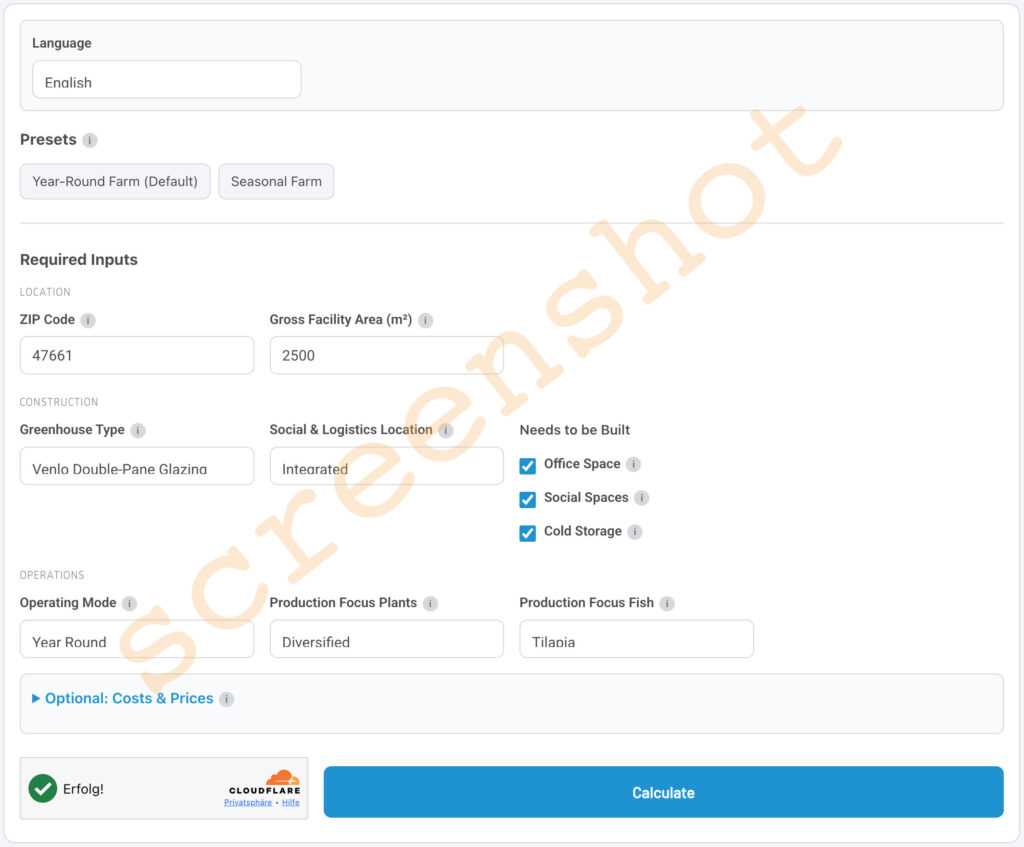
The buttons above the input form can be used to load prepared example scenarios. Currently, two presets are available: a year-round system with 2,500 m² and a seasonal system with 1,250 m².
When a preset is loaded, the previous entries are overwritten. All values can then be adjusted as usual. The presets are therefore not fixed specifications, but starting points for your own scenarios and comparisons.
ZIP Code
A German postal code is required for the calculation.
This is because location-specific climate data is incorporated into the model. This includes, in particular, factors such as solar radiation, wind speed, and average temperatures. Based on the entered postal code, weather data for that specific area is used to map the calculation to the climatic conditions of the location within Germany.
The postal code is not used for address processing, but solely for the climatic classification of the project. It is an important starting point for the location-specific modeling and particularly influences calculations related to weather, energy demand, and seasonal variations. No data is used or stored beyond its use in the calculator.
Gross area of the facility (m²)
The gross area of the facility describes the total area designated for the project.
It forms a central basis for the further allocation of space within the model, for example, for production areas, technical areas, and other functional units of the facility.
Which components are generally included is explained in the tooltip next to the input field. External areas that may belong to the property but are not part of the actual facility area are not included. These include, in particular, access roads, parking areas, and other non-buildable or non-project-related land areas.
Specifying the gross area is important because it defines the spatial framework of the entire project and thus has a significant influence on the subsequent modeling of the facility.
Greenhouse type
The type of greenhouse influences key technical and economic assumptions in the model.
These include, in particular, investment costs, structural parameters, heat losses, ventilation concepts, and the fundamental operational design of the facility. Selecting the appropriate type is therefore important because different greenhouse shapes are based on different assumptions within the model. The following greenhouse types are currently available in the calculator:
Venlo single
Venlo-type greenhouses are the standard in greenhouse construction and can be built to virtually any size. This is why this greenhouse design rightly occupies the highest scaling level in Central Europe. The greenhouse size is based on three-section structures (9.6m wide) with a truss spacing of 4m.
The “Venlo Simple” is a classic Venlo greenhouse with single glazing. This type represents a typical glass greenhouse construction with the corresponding structural and climatic properties.
Venlo Double
Venlo blocks are available in energy-saving and basic versions. The “Venlo Double” type describes a Venlo greenhouse with insulated glazing in the roof area and triple-wall polycarbonate panels on the side walls. Compared to the basic version, the insulation value of this building envelope is correspondingly significantly higher.
PE side ventilation
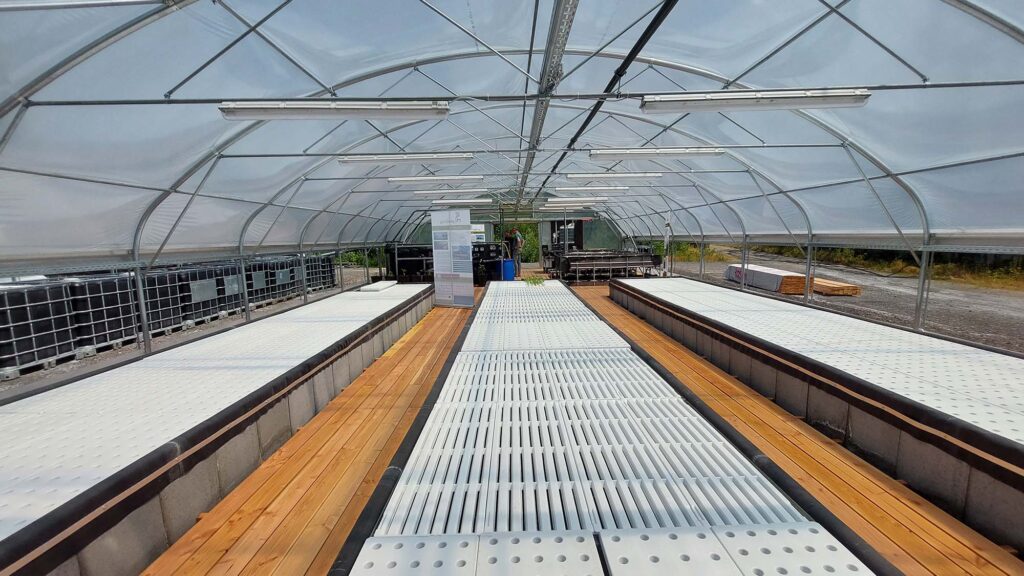
Here, we are starting with a polytunnel greenhouse made of double-layered PE film. A blower creates an air cushion between the two layers of film, significantly improving the insulation of the enclosure. Ventilation is provided through side openings, where the film can be rolled up on both sides of the greenhouse using stepper motors. Polytunnel greenhouses are usually smaller than large Venlo blocks, so we classify them as medium size. The example shown is the “Hansaponik” in Dortmund, two 200-square-meter polytunnel greenhouses built using lightweight construction. We were commissioned to design and build these as part of the EU project proGIreg.
PE roof ventilation
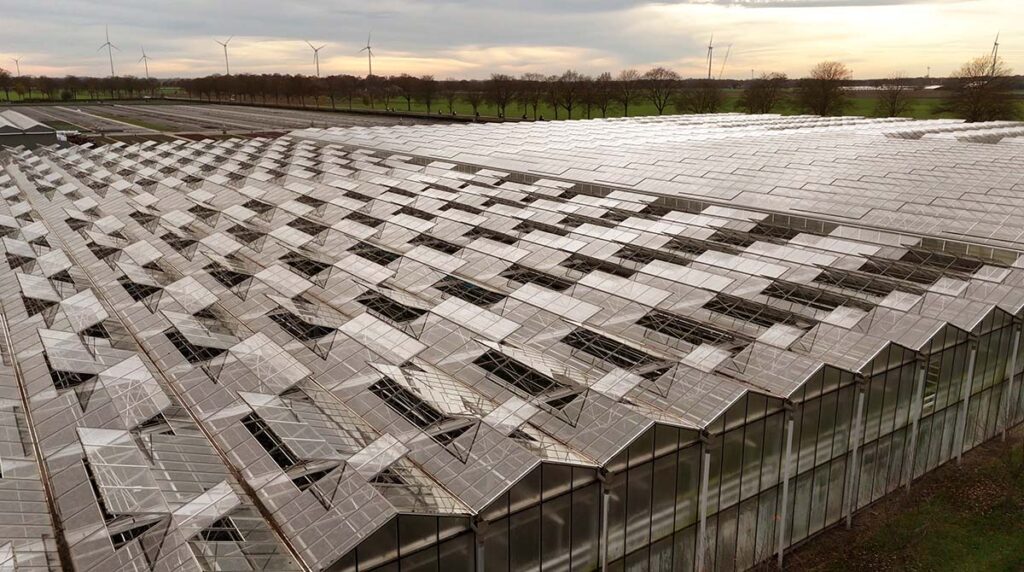
Here too, a double-layered foil greenhouse with air cushions between the foil layers is assumed. However, this variant is taller than the “PE side ventilation” type and belongs to the group of so-called wide-span greenhouses. Unlike the side-ventilated variant, ventilation here occurs via the gable, similar to Venlo greenhouses. This results in differences in the ventilation concept and technical assumptions in the model.
Social and logistics sector
This field determines whether social and logistics areas should be included in the specified gross floor area or located outside of it. If “integrated” is selected, the calculator assumes that these areas must be deducted from the available gross floor area for the project. This selection does not affect the modeling of investment costs.
Conversely, selecting “external” means that these facilities are located (or will be located) in areas that are available in addition to the specified gross floor area.
Office space, sanitary facilities and cold storage
In addition to specifying the areas where social and logistics facilities should be located, we also determine whether these facilities need to be built at all.
For offices, social and sanitary facilities, and cold storage, we indicate separately whether these areas need to be newly constructed or already exist. These fields serve to better reflect project-specific differences in infrastructure. If the respective areas already exist or are provided through other means, the corresponding investment costs do not need to be recalculated.
This allows the calculator to be adapted to projects where individual functional areas already exist or can be shared within another project.
Operating mode of the aquaponics system
The operating mode is one of the most important inputs in the calculator, as it determines the fundamental orientation of the plant. It particularly influences the modeling of energy demand, production period, yields, and operating costs. The calculator currently offers three options:
Year round
This plan assumes that the system will operate year-round. This option allows for continuous production but typically results in higher energy consumption, especially during the colder months. In this operating mode, the greenhouse will be equipped with highly efficient double screens (energy-saving and blackout screens) on the roof and side walls. Appropriate assimilation lighting will also be incorporated.
Seasonal
In seasonal operation, production is concentrated on the natural growing season. This reduces technical and energy requirements, but at the same time limits the production period to a specific part of the year. In this operating mode, the greenhouse is only equipped with a shade screen in the roof area.
Extended seasonally
This operating mode represents an intermediate form between seasonal and year-round operation. The goal is to effectively extend the season and thereby achieve a noticeable increase in productivity without incurring the energy costs of full year-round operation. In this operating mode, the greenhouse is designed, for example, with a simple energy screen in the roof area. No additional assimilation lighting is planned. During the extended season, the greenhouse is kept essentially frost-free or at a moderate temperature using simple fan heaters (lower investment, but also lower efficiency).
This option can be particularly interesting in combination with fish production, as the extended production period can be easily coordinated with the fish harvest. From our perspective, this is a particularly valuable option when no waste heat is available to supply a facility with heat year-round.
Production focus plants
This field defines the crop production focus of the system.
This isn’t about whether certain crops can be grown at all, but rather about which crop groups form the core of hydroponic production and thus significantly influence the modeling.
It’s important to note that different cultivation methods can be used in hydroponics, particularly DWC, NFT, and growbeds. These differ in their handling, land use, and practical management. However, the most crucial factor for the modeling is the nutrient requirement associated with the chosen production focus.
Different plants sometimes differ considerably in their nutrient requirements. Therefore, for the nutrient balance, it’s important to know whether the focus is on crops with low, medium, or high nutrient requirements. Fruiting vegetables generally have a significantly higher nutrient requirement than leafy vegetables.
The following focus areas are currently available in the calculator:
Fruit vegetables
This approach assumes a production focus on crops with comparatively high nutrient requirements. These typically include fruit-bearing crops such as tomatoes, peppers, or zucchini, and others where the demands on nutrient supply and production management are higher. A characteristic of fruiting vegetables is that the plants remain in the system for an extended period and are harvested continuously.
Leafy greens
Here, the focus is on crops with lower nutrient requirements. This production approach therefore differs significantly from fruit-focused systems, particularly with regard to the nutrient balance. This often also applies to the harvest (as a whole). Typical crops here include lettuce, spinach, or other varieties whose leaves are consumed. Short production cycles, which allow for crop rotation, are typical for these vegetables.
Diversified
This option represents mixed cropping with alternating or differently composed crops. The modeling determines the nutrient requirements based on predefined area proportions for the different vegetable types.
This cultivation method is particularly well-suited for operators of smaller facilities who aim for direct sales of their products. In this case, the ability to cultivate many different products simultaneously is especially important. However, this comes at the expense of available growing area, as this mode requires more transport infrastructure.
Production focus fish
This field sets the focus for aquaculture.
The selection influences key assumptions in the modeling, particularly regarding husbandry conditions, temperature requirements, growth dynamics, feed requirements, and production output. Different fish species have different biological and operational requirements that directly affect the calculation. Further information on suitable fish for aquaponics can be found here.
The following species are currently available for selection in the calculator:
Tilapia
Tilapia is a warm-water fish and is particularly well-suited for systems where higher water temperatures can be maintained year-round. The species is widely used in aquaponics, is very robust, and is frequently associated with warm-water production systems. In modeling, this has a significant impact on temperature assumptions, energy requirements, and production conditions.
Trout
Trout represent a cold-water species with significantly different requirements for temperature control and husbandry. Compared to warm-water systems, this results in different operational and technical parameters that must be incorporated into the model. The selection of this species therefore substantially influences the assumptions regarding the aquaculture production method.
European catfish
The European catfish represents another interesting option for aquaculture, differing in its requirements and production characteristics from both tilapia and trout. Here, too, species-specific assumptions regarding husbandry, temperature requirements, and production output are incorporated into the calculation.
This selection defines the focus of fish production in the model.
It does not mean that other species are excluded, but rather determines which species-specific assumptions the calculator uses in the background.
Optional: Costs and prices
Under “Optional: Costs and Prices,” you will find further important settings for your project idea.
Here, you can enter your own cost estimates for various reference values and adjust prices to your local market and your specific sales opportunities. The more precise you are in this regard, the more reliable and meaningful the calculation will be.
If you plan to enhance some of your products, for example, by offering smoked fish, please specify the average product price you aim to achieve across your entire product range.